
 Expertise Since 1987
 Rated Excellent
 FLEXIBLE PRICING
Guest Booklet: Safety & Vessel Guidelines
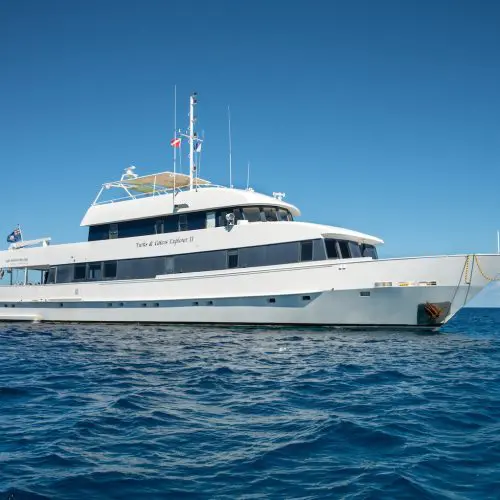
This page contains the full, safety guidelines, vessel specifications, and onboard policies for the Turks & Caicos Explorer II.
The onboard quick-reference booklet provides an overview of essential information. This digital version expands on those details and serves as the official reference for guest safety procedures, dive operations, vessel systems, sustainability policies, and guest responsibilities.
All guests are required to attend mandatory briefings conducted by the Captain and crew. These written guidelines are provided to support — not replace — those briefings.
Please review the sections relevant to your stay and direct any questions to the Captain or crew at any time.
Your understanding and adherence to these procedures ensures a safe, efficient, and enjoyable experience for everyone onboard.
Table of Contents
WELCOME ABOARD
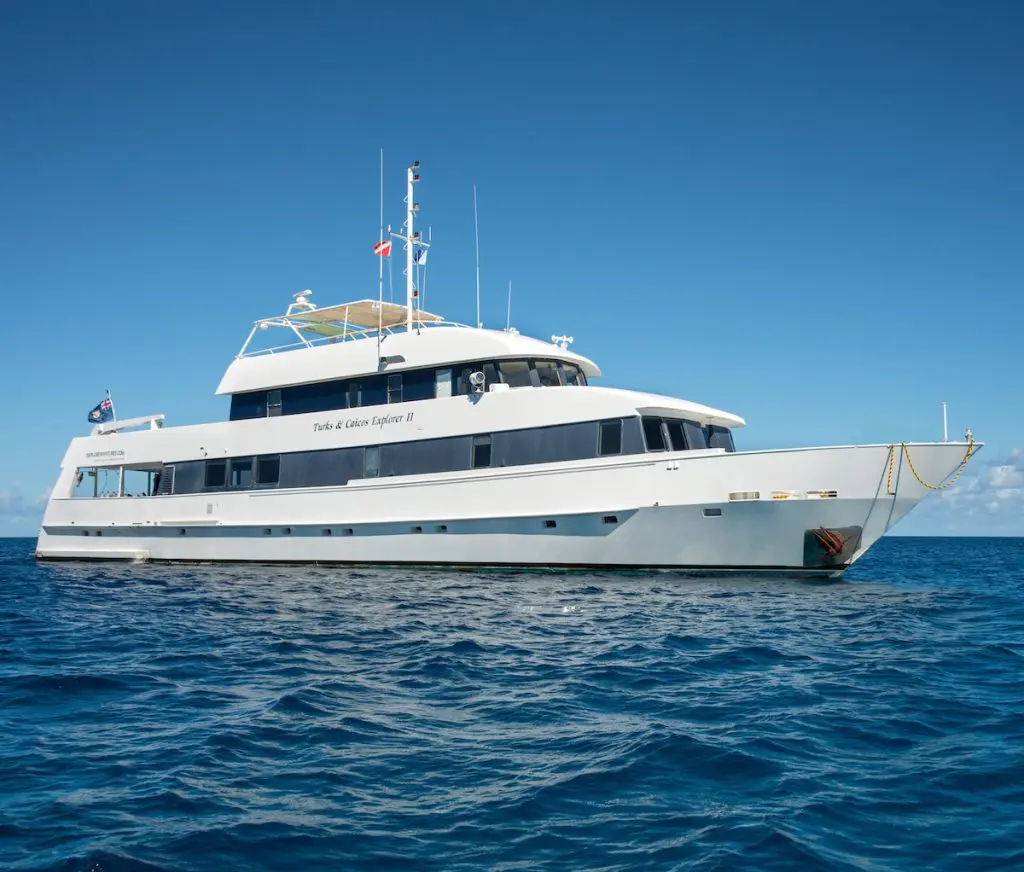
Hello from the Turks & Caicos Explorer II crew!
We, your captain and crew, are here to serve you and make this your most comfortable and enjoyable voyage ever! If there is anything that any of us can do to make your trip more pleasurable, please do not hesitate to tell us – that’s why we’re here!
Your stay aboard will provide you with countless opportunities to dive and simply relax. If you have a request or problem, please make it known during the trip! We cannot help you after you leave us.
Your vacation is very important to us, and we want you to enjoy your stay with us. When you leave the Turks & Caicos Explorer II, we would like you to take with you many fond memories and come back soon to visit us again!
· Your Captain and Crew
SAFETY
Safety carries extra importance on a vessel, where movement, weather, water access, and shared spaces all require attention. Please take time to review the following procedures carefully.
Safety Essentials & Fire Safety
- There are smoke detectors and fire extinguishers located throughout the vessel, including inside guest cabins.
- The fire extinguishers are ABC powder extinguishers; to use them, remove the pin, aim at the base of the fire, and squeeze the trigger.
- In the event of a fire, immediately notify a crewmember. Do not attempt to fight a fire unless it is very small and safe to do so.
- Life jackets are stored on the sundeck and are clearly marked for easy access.
- Each life jacket is equipped with both a light and a whistle for visibility and signaling in an emergency.
Off-Limit Areas
- Please use caution when moving around the vessel, especially at night or while the boat is underway.
- Guests should not go outside alone at night during transit.
- The dive platform is off limits while the vessel is moving.
- Please stay clear of the bow during anchoring, mooring pickup, and docking, as these are active working areas.
- The galley, engine room, and any areas marked “Crew Only” are restricted.
- The compressor room may only be entered when accompanied by a crewmember.
- When using stairs or ladders, always keep one hand free and one hand on the railing for stability.
Room Information
- Each cabin is equipped with individually controlled air conditioning for your comfort. If you experience any issues with temperature or airflow, please notify a crewmember.
- The vessel uses a vacuum toilet system to conserve water.
- Small amounts of toilet paper are acceptable, but nothing else should be flushed.
- If your toilet does not reset within a few minutes, please notify the crew so it can be addressed promptly.
- Do not leave any devices charging in your cabin unattended. Use the designated charging station for anything other than your phone
Emergency Procedures
In Case of Emergency
- The primary muster station is located on the sundeck, with a secondary muster station on the bow if needed.
- In an emergency, guests will hear one long blast on the ship’s horn or a yelp through the PA system. The all-clear signal is indicated by five short blasts on the horn.
- When directed, guests should proceed calmly to the assigned muster station and await further instruction from the crew.
- Guests should bring their life jacket to the muster station unless otherwise instructed.
What to do in an emergency
- If you discover a fire, notify a crewmember immediately and alert those nearby.
- If the situation requires evacuation, proceed calmly to the muster station and follow crew instructions.
- In the event of a man overboard, throw the nearest life ring and alert the crew immediately.
- If you believe someone is missing, report it right away so the crew can respond quickly.
- If anything in the safety briefing is unclear, please ask the Captain or crew for clarification.
- Always remain calm and follow crew instructions — the crew is trained to manage emergency situations onboard.
GETTING SETTLED
Upon Arrival
- Once aboard, take a few minutes to get comfortable and familiarize yourself with the layout of the vessel.
- Head to the dive deck to choose a station and begin setting up your gear for the week.
- Collect the appropriate weights and confirm with the dive staff whether you will be diving air or nitrox.
- If you have any questions about setup or equipment, the crew is available to help at any time.
General Information
- Drinking water onboard is safe and available throughout the vessel.
- The vessel produces freshwater onboard, but it remains a limited resource, so conservation is appreciated.
- Wet clothing and dive gear should remain on the dive deck and not be brought into interior spaces.
- Freshwater showers and towels are available on the dive deck for use after dives.
- Personal dive gear that is not attached to a tank should be stored in your assigned bin.
- Smoking is permitted only in designated outdoor areas, including the bow and fly bridge.
- The possession or use of illegal drugs is strictly prohibited onboard.
ILLEGAL DRUGS OF ANY SORT ARE PROHIBITED ON BOARD THIS VESSEL.
THE “NO TOLERANCE LAW” IS IN EFFECT AND WILL BE STRICTLY ENFORCED.
DAILY LIFE
Daily Schedule
- A typical day begins with a light breakfast available at 6:30 a.m., followed by a hot breakfast served between 7:00 and 8:00 a.m.
- Two morning dives are usually followed by lunch around midday.
- Two afternoon dives are scheduled before dinner, which is typically served at 6:30 p.m.
- Most evenings include an optional night dive.
- A daily schedule outlining dive sites and timing is posted each morning in the salon.
- Guests are welcome to participate in as many or as few dives as they choose throughout the week.
- Please be reminded that departure time on Saturday morning is 9:00 am. The crew needs time to prepare the vessel for arriving passengers. They will be happy to assist you with taxi arrangements to the airport. We can also arrange to hold your luggage until your taxi time.
Communications
- The boat is equipped with a cellular phone that can be used for incoming and outgoing calls.
- If you would like to use the phone to make a call, please ask one of the crew members.
- Please be aware that a charge is assessed for both incoming and outgoing calls.
On Board Charges
- Though all meals (except Friday’s dinner), beverages, transportation between islands, and much more has been taken care of with your trip payment, there are additional items which you may charge to your on board bill. These include retail items (shirts etc.), incoming and outgoing telephone calls, photographic and scuba instruction, rentals, land tours, and crew gratuities.
- Crew gratuities are not included in your package. The crew works very hard, 7 days a week and up to 12 weeks at a stretch, providing the best possible service for our guests. The industry standard for crew gratuities on dive trips (if of course you are happy with the service which you have received) is around 15% of the retail package price per passenger. Your generosity will be greatly appreciated.
- The bill may be paid at the end of the trip using Visa, MasterCard, American Express, Discover card, or USD cash. Personal checks are not accepted on board, and we are unable to cash credit card charges.
DIVING
Safety Standards
- The vessel offers up to five dives per day at scheduled times to allow for proper surface intervals and safe diving practices.
- A crewmember is always on watch while divers are in the water, monitoring bubbles and surface activity.
- Guests must notify the crew each time they enter the water, even if they are only swimming or snorkeling.
Before Entering the Water
- All divers must be certified as scuba divers by an internationally recognized accrediting organization.
- All divers must have logged at least one dive within the 12 months prior to boarding the vessel or participation in a refresher course on board is strongly encouraged.
- All divers are required to attend the briefing on each different dive site to learn the peculiarities of that particular location. A briefing will be given every time the boat changes locations.
- Each diver must have a personal dive computer – not one computer per buddy team. If you do not have a computer, there are some available to rent onboard.
- Liability releases must be completed without modification and given to the Captain.
- Every diver must sign the diver responsibility statement
While Diving
- NEVER GO IN THE WATER WHILE THE ENGINES ARE RUNNING, UNLESS DIRECTED BY A CREWMEMBER.
- For safety reasons, diving activities must cease for the day when the consumption of alcohol begins.
- All divers must adhere to the buddy system, unless certified, equipped and adhering to standards for solo diving. Members of a buddy team should have the same dive times and same profiles and should enter and exit the water together.
- Solo diving is only possible if the diver can provide valid SDI Solo Diver certification and dive with the required equipment. Solo diving may be restricted at certain sites.
- On each dive, we record your time in, your time out, your ending PSI and your maximum depth.
- We do NOT allow decompression dives; however, if you do exceed your no-deco limit, follow your computer.
Dive limits
- The maximum dive depth is 130 ft / 40 m, or 110 ft / 33 m when diving Nitrox 32.
- A safety stop at 15 ft / 5 m for a minimum of 3 minutes is expected on every dive, or as directed by your dive computer.
- Divers should return to the vessel with a minimum of 500 psi / 50 bar remaining, while still completing a full safety stop.
- We encourage conservative dive profiles, especially with multiple dives over multiple days.
Night diving
- A primarily light is required plus a battery-powered marker light must be worn by each diver, even if they carry a backup light source. They are available on board. Please avoid plastic cyalume sticks.
Not permitted
- Please note that, due to a combination of staff and equipment logistics, insurance requirements and local diving regulations, re-breathers, doubles (other than pony bottles) and diver propulsion vehicles (DPVs) may not be used aboard the Turks & Caicos Explorer II.
Entries, Exits & Dinghy Use
- Water entries are made using a giant stride from the stern dive platform. Please ask for assistance if you have special requirements.
- Guests should not jump over the ladders when entering the water.
- Cameras will be handed down by the crew once the diver is already in the water.
- If separated from your buddy, search for one minute and then begin a safe ascent if not reunited.
- The vessel may swing at anchor, which can affect your position during ascent and safety stops.
- Stern hang lines are provided and should be used for stability during safety stops.
- If the line moves away due to vessel swing or diver traffic, remain calm and allow the vessel to return toward you rather than swimming after it.
- Each diver is strongly encouraged to carry a surface marker buoy (SMB) for use during ascent.
- The dinghy is used primarily as a safety and support vessel, not as a taxi service.
- Surface pickups will be made when necessary, but divers are expected to return to the vessel when conditions allow.
- The emergency recall signal consists of four loud bangs followed by a pause, repeated.
- If you hear the recall signal, begin a safe ascent immediately, without completing a safety stop.
Nitrox Considerations
- All divers using nitrox must complete and sign a nitrox liability release at the start of the trip.
- Before each dive, divers must personally analyze their tank and record the oxygen percentage.
- Divers must calculate their maximum operating depth (MOD) and sign the nitrox log before entering the water.
DIVE DECK GUIDELINES
Scheduling Logistics
- The dive site board is updated each time the vessel arrives at a new location.
- The daily dive schedule is posted in the salon and may change based on conditions and timing.
- A conch is blown approximately 15 minutes before each dive to notify guests.
- Unless otherwise advised, the crew will assume guests plan to participate in scheduled dives.
Geography of the Dive Deck
- The camera table is reserved for camera equipment only.
- Drinks and other liquids should not be placed on the camera table.
- Separate rinse buckets are provided, with triangular buckets for gear and a large tank designated for cameras.
- Mask defog solution is available on the dive deck for guest use.
- A charging station is located beneath the camera table for lights and batteries.
- The dive deck head is for liquids only and is not connected to the vacuum flush system.
Gear
- Weights are available onboard, and guests are encouraged to perform a buoyancy check on the first dive.
- Divers should hold their weight belt buckle during entry to avoid losing weights.
- Lost weights may result in a replacement charge.
- Dive gear should be stored in the cubby beneath each bench seat.
- Wetsuits should be hung on the dive deck and not brought wet into interior spaces.
- Dive towels are assigned daily and should remain on the dive deck.
- Tanks are filled to approximately 3000 psi / 210 bar.
- Tank cap colors indicate the gas mixture, with green indicating nitrox.
- After each dive, remove your regulator and leave the tank uncovered so the crew knows it requires filling.
ECO-FRIENDLY DIVING
Explorer Ventures is aware that as a global dive business, we depend on a fragile marine ecosystem that is increasingly threatened by a multitude of formidable factors. We understand we have an obligation and a responsibility to act as stewards of our environment, so that future generations will be able to enjoy and experience the oceans as we do.
For many years, we have been dedicated to protecting our oceans and limiting environmental impacts through a sustainability management program called Dive Green. Then in 2018, we expanded this effort through international action and became ‘International Year of the Reef’ campaign partners with The Reef-World Foundation, a comprehensive initiative coordinated by the United Nations Environmental Programme (UNEP). In addition, we adopted the Green Fins environmental standards onboard our Caribbean vessels Turks & Caicos Explorer II and Caribbean Explorer II. By fall of 2018, Caribbean Explorer II led the way and became the very first liveaboard to receive an official Green Fins membership. By acting as a pioneering liveaboard fleet for Green Fins and assisting The Reef-World Foundation in establishing targeted liveaboard protocols, we are better able to raise awareness and empower divers worldwide. Expanding our beliefs outside the fleet and acting as a catalyst for change in the dive industry.
In the next 5 years, we aim to continue our commitment to (1) increasing our environmental projects worldwide, (2) working towards the elimination of single-use plastics on our vessels, and (3) wherever possible finding sustainable alternatives for our supply and operational needs.
What is Dive Green?
This program identifies our potential environmental impacts in order to develop and utilize strategies that help us avoid, measure, adjust and ultimately minimize our footprint. This environmental management policy is evolving as new scientific research is presented and our operational procedures become optimized. You can expect this program to develop continually as we expand our global efforts, support, and knowledge base. Currently it covers:
- Sustainability targets and pledges
- Diver and snorkeler behavior
- Reef-safe products and cleaning agents
- Plastics and recyclable products
- Marine life interaction
- Solid waste management
- Mooring buoy programs
- Limited-impact anchoring
- Coral and fish monitoring programs
- Environmental logs and record keeping
- Guest awareness and education
- Crew/staff collaboration and training
- Environmental and scientific donations
- Collaboration with research and conservation initiatives
- Marine Park policies and regulation
True progress takes continuous and coordinated efforts. As we persist with our Dive Green environmental management systems, we encourage you to join in by limiting your own impacts before and during your trip. During your time onboard please listen intently to the Dive Green presentations, forward any questions or concerns to staff, and utilize only the best practices for diving. We thank you in advance for helping to protect our coral reefs!
To learn more about this comprehensive Dive Green strategy and the Green Fins diving policies, please ask your crew or review the booklet located in the salon.
Green Fins + Donations
Explorer Ventures actively educates guests onboard with Dive Green policies, as well as Green Fins diving best practices. In addition, onboard our Caribbean vessels we collect optional donations for Green Fins during the final check-out. 100% of your support goes to the Green Fins initiative – You’re helping to ensure the future sustainability of coral reefs, marine life, and and local communities – and helping to educate and empower other divers to join the cause. We suggest donations be $10-$15 per person, or more depending upon your available contribution. Thank you for diving green!
VESSEL SPECIFICATIONS
The Turks & Caicos Explorer II was made a part of the Explorer Ventures Fleet in 2005.
- Vessel: M/V Turks & Caicos Explorer II
- Registry: Turks & Caicos Islands
- Boatmaker: Swiftships, 1975/1995
- Recommissioned: 2005
- Construction: All aluminum
- L.O.A.: 124 ft
- Beam: 22 ft
- Draft: 8 ft maximum
- Maximum Speed: 14 knots
- Maximum Range: 2,500 nautical miles
- Engines: 2 John Deere diesel main engines
- Generators: 2 generators supplying 110 V AC/220 V AC power
- Freshwater Supply: 2 reverse osmosis watermakers, approximately 5,000 gallons per day combined
- Air Systems: 2 Bauer compressors with Nitrox membrane system, producing 32% Nitrox
- Electricity: 220 V and 110 V AC power (110 V AC 3 prong grounded outlets in all staterooms and bathrooms)
- On the Bridge: Radar with proximity alarm, Global Positioning System (GPS) with location alarm, digital depth sounder/bottom recorder with alarm, satellite telephone, cellular telephone, VHF radios, engine and bilge alarms, internal PA and intercom system
- Public Heads: One on dive deck; private facilities in each stateroom
- Accommodations: 20 passengers in 10 staterooms, all w/private vanities and toilet facilities. Up to 10 staff in crews’ quarters.
- Safety Equipment: Life rafts, life rings/strobes, life vests/strobes, emergency position locator (EPIRB), flares, oxygen and first aid equipment
- Other Equipment: Full service galley and refrigeration, ice machine
- Stereo audio system, salon and upper deck: TV, DVD, USB. Recharging station (phones, strobes, etc).
- Tender: Rigid hull inflatable used for passenger transport
- Accessories: Diving Equipment
THANK YOU
Thank you for choosing to spend your adventure with us. We hope this journey becomes part of your story and that the memories you’ve made here stay with you long after you return home. Kindly leave this booklet in your cabin for the next guest, and we look forward to welcoming you aboard again.
— Your Captain and Crew
