
 Expertise Since 1987
 Rated Excellent
 FLEXIBLE PRICING
Go beyond Providenciales to Northwest Point, West Caicos, and French Cay. See how travelling offshore on a liveaboard changes a week of diving the Turks & Caicos Islands.
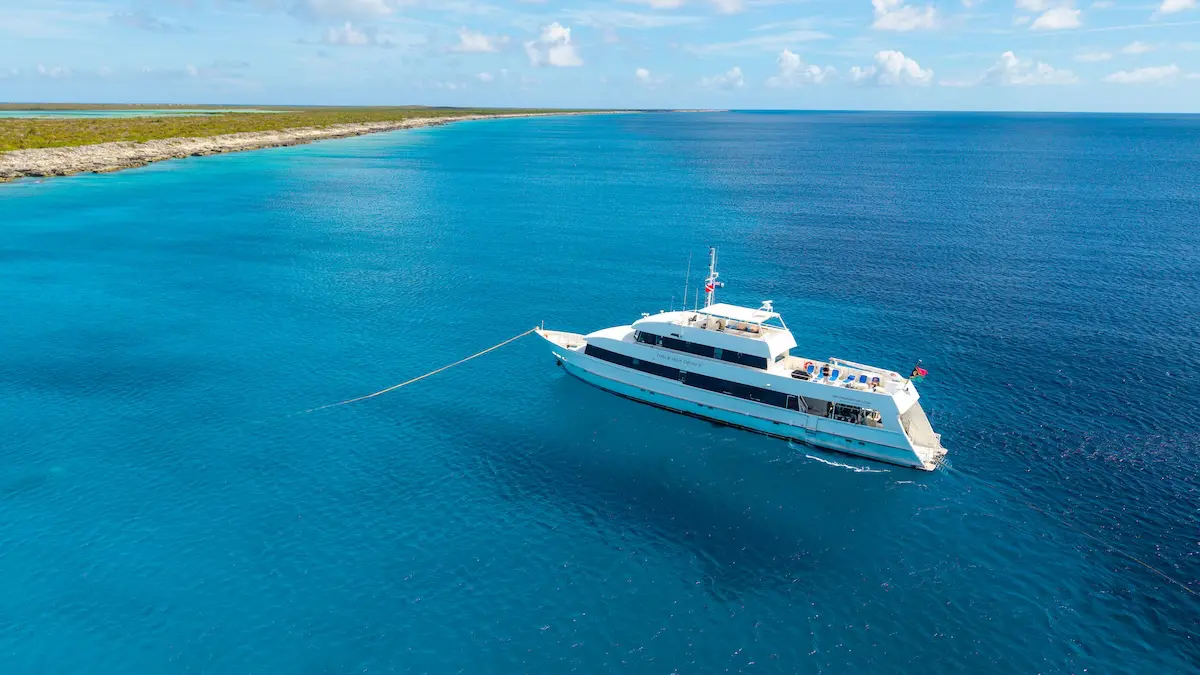
Providenciales gets most of the attention in the Turks & Caicos. Search for diving Provo, and it’s easy to see why. This is where most visitors fly in, where Grace Bay stretches along the north shore and where most of the country’s resort life is concentrated.
For divers, though, it can also be just the starting point.
Board the Turks & Caicos Explorer II liveaboard and the view changes quickly. Instead of returning to the same island after each day of diving, you take your room, dive gear, dinner table, and built-in social life with you. Northwest Point gives way to West Caicos. West Caicos transitions to French Cay. By the middle of the week, Provo will be somewhere over the horizon, leaving the crowds behind
That’s one of the biggest reasons to dive the Turks & Caicos by liveaboard. You don’t have to keep coming back to the same place each day. The boat moves with the diving, cutting out the back-and-forth and letting you wake up right at the dive site.
The Turks & Caicos is bigger than Providenciales
Look at the Turks & Caicos on a map and you start to understand why a liveaboard makes sense here.
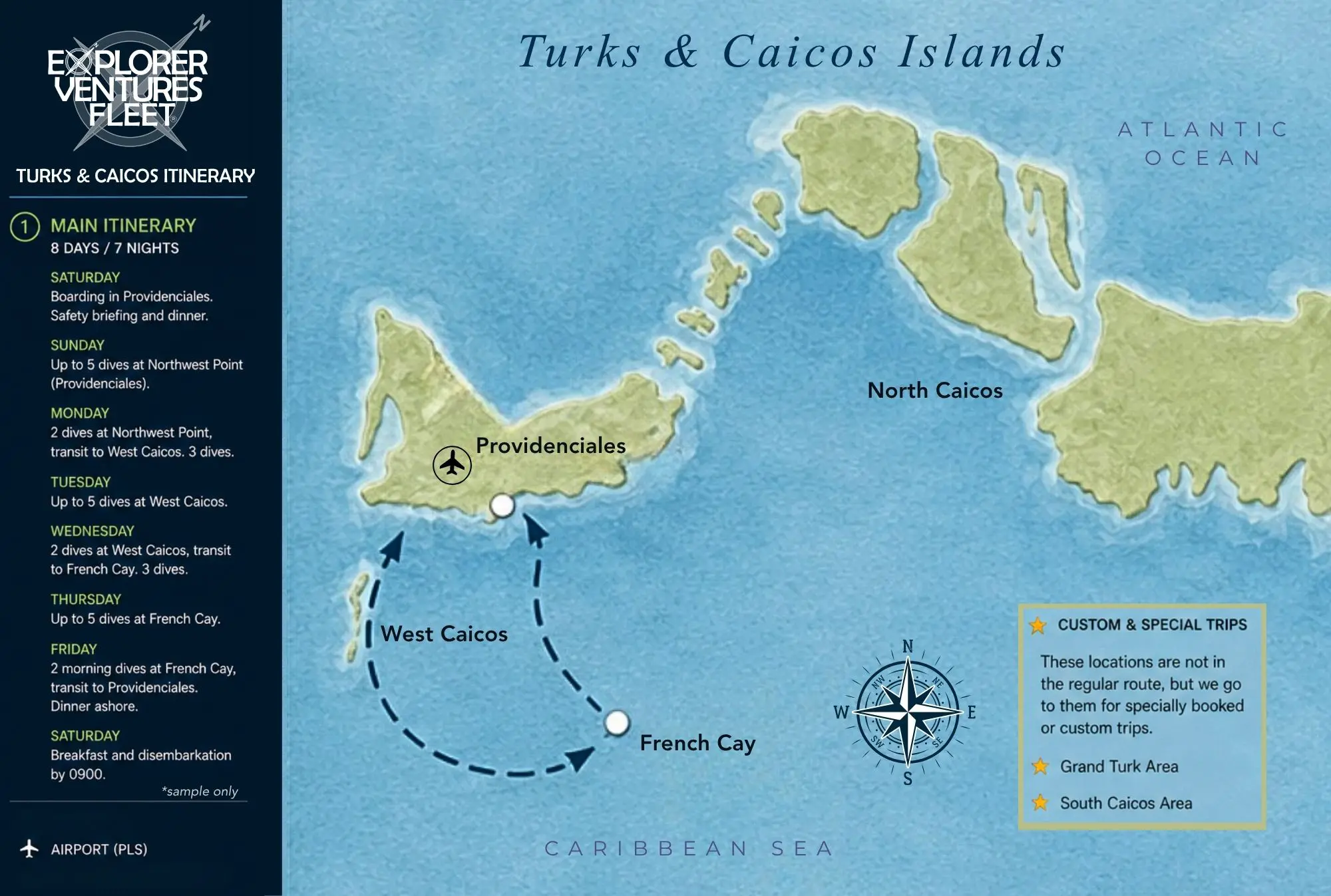
The country is a long smattering of islands, cays and banks surrounded by deep blue Atlantic water. Some of its best-known diving areas sit well away from the main resort strip.
A typical week aboard Turks & Caicos Explorer II begins around Northwest Point, on the western end of Providenciales, before heading offshore to West Caicos and French Cay. The exact route isn’t fixed. Weather, sea conditions and logistics ultimately determine where the captain takes the vessel and when. That flexibilityworks in your favor.
John saw it firsthand during his May 2025 trip. Calm conditions opened up more possibilities, and he credited the captain’s dive-site choices with taking full advantage of them. One dive in particular stood out:
“The night dive at French Cay was EPIC by any standard!” — John, verified guest, May 2025
With the boat already out at sea, the crew can make decisions around the conditions rather than commuting hours back to Provo at the end of every dive day.
Northwest Point: Start the Week at the Edge
You don’t have to travel far from Provo to find dramatic diving.
Northwest Point sits at the western edge of Providenciales, where the underwater terrain drops away into deeper water. Walls, sponges, soft corals and fish life make it a natural place to begin the week before heading farther offshore.
It doesn’t take long to settle into the liveaboard routine. Your gear has its place on the dive deck and stays set up between dives. When the briefing is finished and it’s time to go, you gear up and head to the dive platform, just a few steps away.
There’s no hauling your dive bag every morning or loading everything up again at the end of the day. It may sound like a small thing, but after several days of diving, it’s one of the pleasures of doing the Turks & Caicos the liveaboard way.
We’re only scratching the surface of the individual sites here. For a closer look at where you’ll dive, underwater terrain and what you may find at different sites, visit our Diving in the Turks & Caicos Islands guide.
West Caicos: Walls, Blue Water and Sharks
West Caicos is the kind of place that shows you the true scale of Turks & Caicos diving.
The island itself is largely undeveloped, and underwater the shallow platform gives way to walls dropping into crystal clear blue water. Keep an eye out from the wall for Caribbean reef sharks, turtles and rays, then turn your attention back toward the reef structure for fish life and smaller subjects.
It’s one of those places where a wide-angle photographer can spend half the dive watching the blue while a macro photographer is happily focused in the opposite direction.
French Cay: A Different Kind of Dive Day
French Cay feels different again.
It’s a tiny, remote cay south of Provo, surrounded by open water. Below the surface, walls and reef structure attract plenty of activity. Resident Caribbean reef sharks are some of the stars here, along with nurse sharks, turtles, rays, jacks and other fish life.
At night, things change. Large black jacks may hunt around the dive site, while lobsters, crabs, eels, octopus, and other nocturnal life emerge from hiding.
Spending more than a single dive in an area gives you time to see those changes. Morning light is different from late afternoon. Animals move through. A dive that was all about the wall earlier in the day may be remembered for a shark encounter the next time around.
Then the sun goes down, you grab a light and hop back in.
More Diving, Less Work
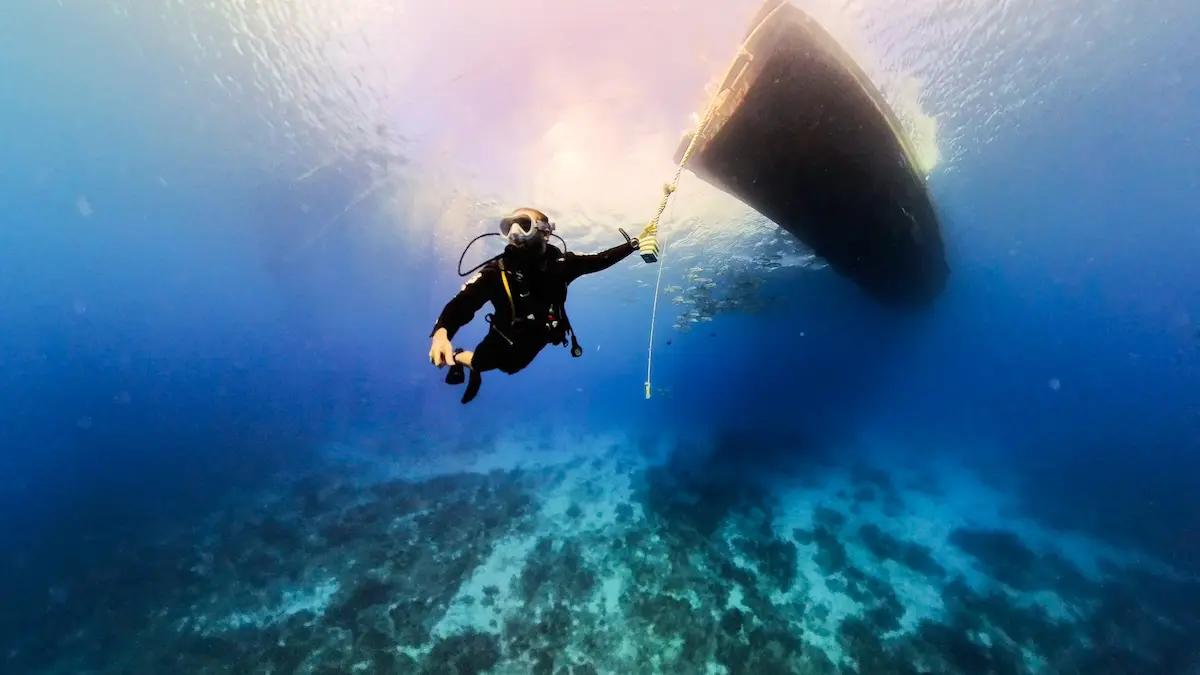
A full dive day aboard Turks & Caicos Explorer II can include two morning dives, two afternoon dives and a night dive. In between, there are meals, snacks, surface intervals and time to recharge and socialize before doing it all again.
All diving is done directly from the vessel. Each diver has a tank station and space for gear, with separate rinse areas for dive and camera equipment. Underwater photographers also have a dedicated camera table, charging areas, storage and a camera rinse tank.
For a guest who joined us for their first liveaboard in August 2024, the effortlessness of it was one of the things that stood out:
“The amount of dives and ease of getting geared up was awesome!” — C.J. F., verified guest, August 2024
How many dives you take part in, is up to you! While there is the option of up to five dives a day, you certainly don’t have to do all of them. Some guests rarely miss one; others sit out a dive, grab a coffee or head upstairs to the flybridge for some quiet time against a backdrop of white sand and azure sea The dives are there when you want them, without having to organize each one separately.
So, What Are We Seeing Underwater?
Sharks are usually high on the wish list, and the Turks & Caicos delivers plenty of chances to see them.
Caribbean reef sharks are regular dive companions, and nurse sharks also turn up as well. Turtles, stingrays and eagle rays are favorites, along with jacks, eels, lobsters, crabs and plenty of smaller reef life.
Guest Nick D. kept a particularly good mental checklist during his July 2024 trip. He reported reef sharks, nurse sharks, stingrays, eagle rays, turtles, jacks, triggerfish, conch, garden eels, moray eels, lobster, crabs, parrotfish, banded shrimp, arrow crabs and more.
The scenery is a big part of the diving too. Walls and reef structure covered in hard corals and sponges drop toward deep blue water, giving photographers plenty of room to frame a passing shark, turtle or ray.
There’s a smaller world worth looking for as well. Seahorses, pipefish, blennies, cowries and other little subjects can easily be missed if you spend the whole dive watching the blue.
That mix keeps the week interesting. One dive may be remembered for a squadron of Eagle Rays cruising past the wall; on the next, the best find could be something tiny a divemaster spots a few inches from your mask.
Diving Here Comes with Some Responsibility
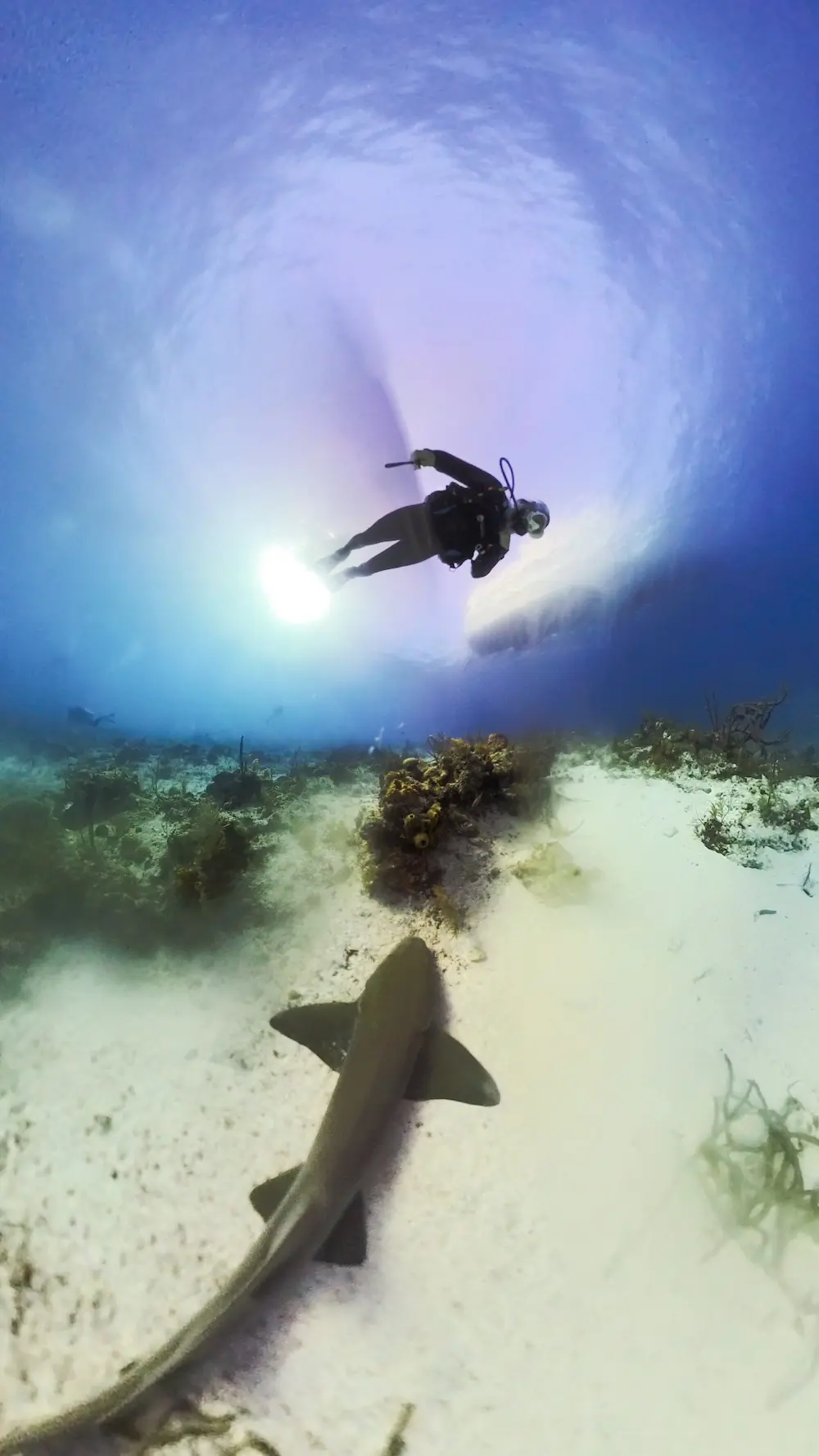
When you spend a week diving the same walls, reefs and marine habitats, you also get a closer look at why the way we dive them matters.
Turks & Caicos Explorer II participates in Green Fins, an internationally recognized program focused on reducing the environmental impacts of marine tourism. It complements our own Dive Green® environmental management program, which has guided Explorer Ventures’ approach to more responsible liveaboard operations since the beginning.
Aboard, that translates into practical things: responsible diver and wildlife interactions, reducing unnecessary contact with the reef, managing waste and plastics more carefully, and helping guests understand the environments we’re visiting. For photographers, it also means getting the shot without putting the reef or marine life in danger.
The condition of the reef itself is part of that conversation. Like many Caribbean destinations, the Turks & Caicos has been affected by a changing climate and coral disease, particularly among hard corals. Despite this,there is still plenty happening underwater — hard corals, sponges, fish life, sharks, turtles, rays and smaller reef residents are all part of what we’re diving to see — but there’s no value in pretending reefs haven’t changed. Just as importantly, there are people working hard to protect these reefs, with strong conservation action throughout the region, including the work of organizations like Turks and Caicos Reef Fund.
For us, responsible diving means enjoying these incredible places while making thoughtful choices about how we interact with them. When you’re making four or five dives in a day, those small choices add up.
You Don’t Need Hundreds of Dives
Turks & Caicos Explorer II is a dive-focused trip, so you need to be a certified diver and comfortable diving in a buddy pair. Divers who haven’t been underwater within the previous 12 months are strongly encouraged to complete a refresher aboard.
While you should be comfortable with open water diving skills, you don’t need an enormous logbook.
Guest, Maria W. joined us in April 2025 as a newer diver and appreciated having the crew nearby while she built her confidence.
“All crew members were always around to make sure I was comfortable with my dive.” — Maria W., verified guest, May 2025
Lisa Ann L. had a different need. As an amputee diver, she requires a little more assistance putting her gear on and taking it off. She wrote after her May 2025 trip that the crew was always available to provide that help and described the diving as “fabulous.”
That’s how we want the dive deck to work. Some guests are highly experienced and prefer to head off with a buddy. Others want a guide or a little more attention. The crew is there to help you enjoy the diving at a level that works for you.
A Week Aboard Is More Than the Dive Count
It’s easy to describe a Turks & Caicos liveaboard by the numbers: seven nights, eight days, three islands, and up to five dives on a full dive day. The week feels a little different once you’re living it.
There’s coffee before the first dive, delicious hot breakfast waiting when you come back and plenty of time around the table comparing what everyone saw. Someone found the tiny critter everyone else swam past. Someone had the shark come much closer on their side of the wall. Yet another captured a photo of a lifetime. By a few days in, everyone knows where their gear lives and has settled into the rhythm aboard.
The crew is a big part of making that work. They’re watching the weather, choosing dive sites, filling tanks, preparing meals, giving briefings and helping divers in and out of the water. When conditions change, the plan can change with them.
Guest, Scott S. summed up that combination after his May 2026 trip:
“The crew does a wonderful job on everything from in the kitchen to leading groups to dive sites.” — Scott S., verified guest, May 2026
For Gilda S., who had already completed 21 liveaboards before joining Turks & Caicos Explorer II in December, the comparison carried a little extra weight:
“We consider it one of the very best.” — Gilda S., verified guest, December 2023
That’s one part of liveaboard diving that’s harder to capture on an itinerary. You come aboard to dive West Caicos, French Cay and Northwest Point, but the week is also made up of everything that happens on the boat between those dives. It’s that combination – great diving, and experienced crew, and easy rhythm of life aboard – that turns a week of dives into a week you’ll always remember.
Resort or Liveaboard? It Depends on the Trip You Want
While there’s some overlap (the diving), a liveaboard and a land-based vacation are not interchangeable.
If you want to spend your mornings diving and your afternoons on Grace Bay, try restaurants around Provo and have plenty of time ashore, a resort-based dive trip could make sense for you.
A week aboard Turks & Caicos Explorer II puts the diving at the center of the trip. We can move from Northwest Point to West Caicos and French Cay, stay out in the diving areas, and fit multiple dives into the day without repeatedly returning to shore. If you’re looking for value without compromise, a liveaboard packs a lot into one vacation. With accommodations, meals, snacks, beverages, alcohol, and a week full of diving included, it’s the clear winner for a dive-focused vacation. You unpack once, set up your dive gear and settle in. From there, the week is built around where you’re diving next, what the conditions are doing, and what you might encounter after your next giant stride.
For divers who have only seen the Turks & Caicos from Provo, there’s a lot more waiting offshore.
Turks & Caicos Liveaboard Diving at a Glance
| Planning Your Trip | What To Know |
| Where does the liveaboard depart from? | Providenciales (Provo) |
| Where does Turks & Caicos Explorer II dive? | Typical diving areas include Northwest Point, West Caicos and French Cay |
| How many dives are offered? | Up to five dives on scheduled full dive days (26-27 in a week) |
| Are there night dives? | Yes, when scheduled and conditions allow, up to 5 per week |
| Do you dive from tenders? | Diving is done directly from Turks & Caicos Explorer II |
| Are there sharks? | Caribbean reef sharks are regularly encountered, with nurse sharks also seen. Other species seen on occasion |
| What else might I see? | Turtles, rays, jacks, eels, lobsters and a mix of larger and smaller reef life |
| Is Turks & Caicos good for underwater photography? | Yes. There are walls, sharks and rays for wide angle, smaller subjects for macro, and dedicated camera facilities aboard |
| Do I need to be an advanced diver? | You must be certified. A refresher is strongly encouraged if you haven’t dived within the previous 12 months |
| How does Turks & Caicos Explorer II support responsible diving? | Through Explorer Ventures’ Dive Green® environmental program and participation in Green Fins, with practices aimed at reducing the environmental impact of liveaboard operations and diving. |
| Why choose a liveaboard instead of staying on Provo? | More time in offshore diving areas, multiple dives each day and no daily return to a resort or marina. Best value for your time and money |
Ready to go beyond Provo? Join us aboard Turks & Caicos Explorer II for a week of walls, sharks, blue water and plenty of time underwater.
TURKS & CAICOS DIVING FAQ
Is a liveaboard the best way to dive the Turks & Caicos?
A liveaboard is a great choice for divers who want diving to be the focus of their trip. Turks & Caicos Explorer II travels beyond Providenciales to diving areas including Northwest Point, West Caicos and French Cay, allowing guests to spend more time offshore and complete multiple dives each day without returning to a resort or marina.
Where does Turks & Caicos Explorer II dive?
Typical diving areas aboard Turks & Caicos Explorer II include Northwest Point off Providenciales, West Caicos and French Cay. The exact itinerary and dive sites vary depending on weather, sea conditions and other operational considerations.
How many dives can you do on a Turks & Caicos liveaboard?
Turks & Caicos Explorer II can offer up to five dives on scheduled full dive days, including a night dive when conditions and the itinerary allow. Add to that two morning dives on the penultimate day, guests can enjoy up to 27 dives in a week. Guests can choose which scheduled dives they want to join.
Will I see sharks while diving in the Turks & Caicos?
Caribbean reef sharks are regularly encountered while diving in the Turks & Caicos, and nurse sharks are also seen. Other marine life can include turtles, stingrays, eagle rays, jacks, eels, lobsters and a wide variety of reef fish.
Do I need to be an advanced diver for Turks & Caicos Explorer II?
You must be certified an advanced diver comfortable underwater in a buddy pair, but you do not need a set number of logged dives to join Turks & Caicos Explorer II. Warm, clear water provides an ideal setting to get more experience. Divers who have not dived within the previous 12 months are strongly encouraged to complete a refresher.
How does Turks & Caicos Explorer II support responsible diving?
Turks & Caicos Explorer II participates in Green Fins and operates within Explorer Ventures Fleet’s Dive Green® environmental management program. These programs support more responsible liveaboard operations, diver and wildlife interactions, and practices aimed at reducing impact on the marine environments we visit.
SEO
SEO Title:
H1:
